
Cette étude n’est pas encore disponible en français ; elle est présentée en anglais.
DAIS Insights · Briefing 03
AI at the Regulator
This briefing reviews ten years of licensing, inspection and tracking records from environmental and municipal programmes, and compares them with regulators abroad. It shows what automation fixed, what it left undone, and where artificial intelligence is worth the money.
- 4.5%Share of fine value collected under one national violations schedule, where half the value was cancelled
- 40% → 0Licensing visits in backlog before and after a digital platform
- 91%Municipal complaints filed under two generic labels, so their content is found only by reading them
In this briefing
At a glance
- The signal
- The large gains in environmental and municipal regulation came over the past decade from automation, not from AI. Digital platforms cleared backlogs, met service times and applied fee schedules almost without error. The role of AI is therefore narrower: it reads what forms cannot structure, finds patterns that rules cannot state, and sees what no register records. The case is for a few targeted AI features, not for new AI infrastructure.
- Why it matters
- AI is now presented to regulators as the next step after digitalisation. However, investing in the wrong order automates blind spots instead of removing them.
- What we found
Rules already perform the routine work: 98% of licence fees matched the schedule, and a digital platform completed every licensing visit within its service time.
Enforcement is the weakest link: only 4.5% of fine value was collected under one national schedule.
The remaining gaps lie in text and records: complaints sit in free text, and visits that find no violation go unrecorded.
AI adds most where staff must read or cannot see: abroad, satellite imagery found over three times more dumping sites than field patrols.
Some “AI” projects require only statistics: five checklist items predicted a site’s overall compliance.
- What it means for each party
Regulators and municipalities: fix records and rules first, then add a few AI features.
Technology providers and investors: the market lies in reading text, joining registers and remote sensing, not in replacing inspectors.
- The catch
- AI learns only from what is recorded, and it pays only when enforcement follows the alert.
1Ten years, three phases
Over the past decade, DAIS designed or operated licensing, inspection and tracking programmes for national environmental regulators and large municipalities. The records of these programmes show three distinct phases (Exhibit 1).
- Paper and basic devices (before 2018). Surveyors used handhelds with basic software, or printed forms keyed in afterwards. The quality of the data was poor: the same answer appeared in up to 17 spellings, and 171 records shared one default GPS point. Waste manifests remained on paper, and no one verified them.
- Automation (2018–2025). Licence applications, fees, violations and complaints moved onto digital platforms. Inspection moved last: in one major city, licensing visits were still scheduled and reported by hand until 2024. Electronic waste manifests, designed in 2022 with no paper route, were rolled out in 2024.
- AI era (2026 onwards). The question is which remaining problems AI can solve.
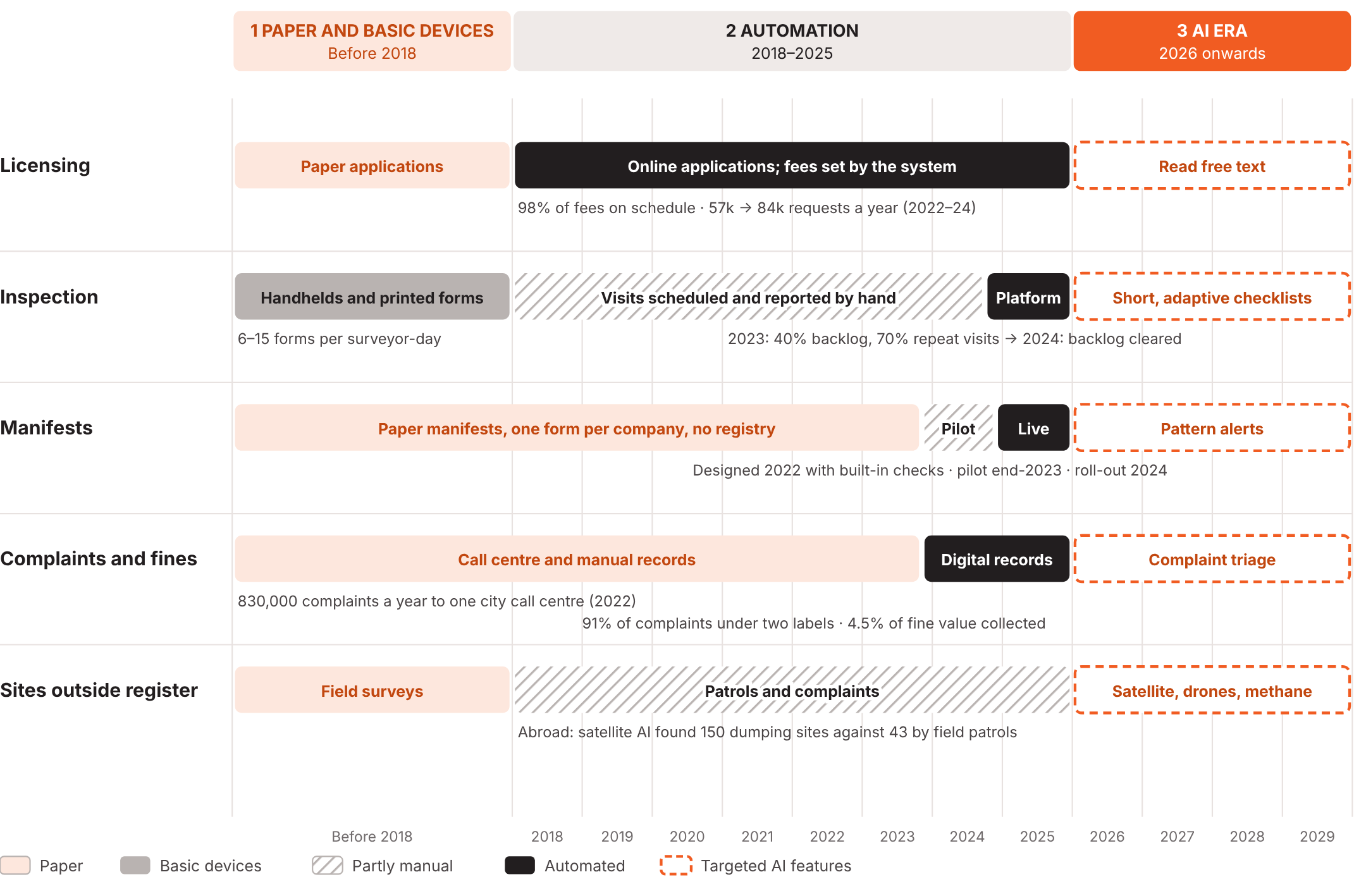
Inspection was automated last; AI is left with what rules and registers cannot do.
2What automation delivered
Automation solved the problems of speed and consistency. In the licensing programme of a major city, requests grew from 57,471 in 2022 to 84,320 in the first eight months of 2024. While visits were managed by hand, 40% of requests were in backlog, 70% of sites required a repeat visit, and each inspector had three productive hours a day. Once the same visits ran on a digital platform, 20 inspectors completed 3,809 requests in one quarter, all within the service time.
The same pattern holds elsewhere. On a national licensing platform, 98.3% of collection licences carried exactly the scheduled fee, and most exceptions resulted from a fee change or a typing error. For these tasks, rules are sufficient; AI would therefore add cost without adding value.
3What automation left undone
Automation increased the volume of records, but not their usefulness. Five gaps remain:
- Enforcement: under one national violations schedule, only 4.5% of the value of fines was collected. Cancellation rates ranged from 15% to 74% between regions, although the schedule and platform were the same.
- Free text: 91% of complaints were filed under two generic labels, so the 15% that concerned licensing could be found only by reading them. Similarly, simple rules can read typed capacities for only 54% of import and export licences.
- Registers: one city holds nine different counts of establishments, with the largest about 2.5 times the smallest, and four agencies inspect the same premises separately.
- Missing visits: inspectorates record violations but not the visits that find none; therefore, no hit rate can be calculated.
- Static risk: risk tiers follow the activity code alone and ignore the record of each operator. As a result, some applicants declare a similar low-risk activity to obtain an instant licence.
4Where AI is worth the money
DAIS tested candidate uses of AI on the programmes’ own data and on benchmarks abroad. Each task calls for one of four investments: rules, statistics, better data or AI (Exhibit 2).
| Task | What the data showed | Best use of money |
|---|---|---|
| Fees and routing | 98.3% of fees on schedule; every visit within service time | Rules suffice |
| Data validation | Placeholder phone numbers in 21% of records; one GPS point for 171 sites | Rules suffice |
| Checklist design | Five items predicted the full checklist result | Statistics suffice |
| Inspection targeting | Visits that find no violation are not recorded | Data first |
| Register matching | Nine establishment counts for one city | Data first, then AI matching |
| Reading complaints and free text | 91% of complaints under two labels; 46% of import and export capacities unreadable by rules | A targeted AI feature pays |
| Review of violations before approval | A model’s top fifth of flags caught 45% of cancellations, against 34% for the best rule | A targeted AI feature pays, once practice is consistent |
| Tracking patterns | Built-in checks since 2024; little history yet | Rules first, AI as history builds |
| Detecting sites outside the register | Abroad: satellite AI found 150 dumping sites, against 43 by field patrols | A targeted AI feature pays, if enforcement follows |
Two results deserve attention. First, the cancellation model learned mainly from fine size and issuing municipality; it therefore reflects inconsistent practice, which consistent rules would largely correct. Second, the assumed halving of visit times from 2027 can come from shorter adaptive checklists, which require statistics, not AI.
5Where AI does more: seeing beyond the register
Abroad, AI plays a larger role where automation cannot reach: activity that no register records. Three uses stand out:
- Spotting what is not registered: in Abu Dhabi, an AI pilot on satellite imagery identified 150 illegal dumping sites, against 43 found by field patrols in the same period. Similarly, DAIS’s MethaneMapper applies AI to satellite imagery to locate dumpsites and estimate their methane emissions, within about 10% of measured values. Drones then add detail at site level; England’s environmental regulator now deploys 33 of them against waste crime.
- Faster investigations: comparing images before and after an event shows when a site changed; in a European pilot across more than 100 municipalities, this shortened investigation times.
- Targeting and early intervention: where every inspection outcome is recorded, risk models can roughly double the violations found with the same inspections. Prediction also limits harm: in two US cities, 52% of restaurants flagged by a model using anonymised search and location data were unsafe, against 23% under routine inspection, so officers could act before food poisoning spread.
However, detection pays only if enforcement follows. In Brazil, only 1.3% of deforestation alerts in 2019–2020 led to a fine or an embargo. A regulator collecting 4.5% of fine value faces the same risk.
Sources: Environment Agency Abu Dhabi (ISWA 2025); Politecnico di Milano, PERIVALLON project (2025); Hino, Benami and Brooks, Nature Sustainability (2018); Environment Agency, England (2026); Sadilek et al., npj Digital Medicine (2018); MapBiomas and Observatório do Clima (2022); DAIS, MethaneMapper technical report (2025).
6What to do first
Because the order of investment matters more than the technology, DAIS recommends six steps, in this order:
- Record every visit, including those that find no violation.
- Replace free text with codes wherever the answers are known in advance.
- Validate data at entry: identifiers, units, capacities and tolerances.
- Reconcile establishment registers across agencies under a data-sharing agreement.
- Add AI features for reading text, reviewing violations and detecting sites from imagery, and pilot each against a control group.
- Act on every alert, keep staff responsible for every decision, and publish the results.
Method and sources
Source. This briefing draws on records and design documents from programmes that DAIS designed or operated for national environmental agencies and large municipalities in an emerging market over the past decade. No client, region or person is named. Benchmarks come from published sources abroad.
Limits. The tests use historical data only, and no model was deployed. Most benchmark results are pilots or simulations, not independent evaluations.